Left Continue shopping
Your Order

You have no items in your cart

Free Shipping on orders $49+
Manuka honey jar, strawberry fruit crisps, and fruit dip with freeze-dried strawberries and chips

Strawberry Hummus

'Tis the season for unique, creative appetizers!  This year, we've teamed up with our friends at Brothers All Natural to bring you a delicious and unique take on hummus that's sure to be the talk of the table.

Our Strawberry Hummus pairs traditional savory hummus ingredients with a touch of manuka honey and freeze-dried strawberries. It's the unexpected flavor duo your guests didn't expect, but will definitely want more of. 

Luckily, this recipe is as easy to make as it is to devour, so you can whip up a new batch when the first disappears 😉

.

.
Manuka Honey & Freeze-Dried Strawberry Hummus 

Ingredients:

  • 1 can (15 oz) chickpeas, drained and rinsed
  • 1/4 cup (60 ml) olive oil, plus additional for serving
  • 1/4 cup tahini
  • 1-2 garlic cloves, minced (About 1 teaspoon)
  • 1 teaspoon ground cumin
  • 1 1/2 tablespoons Manuka honey
  • 1/4 cup freeze-dried strawberries (About 1/4 oz or 7 grams), crushed into powder (Reserve 1 teaspoon for garnish) 
  • Juice of 1 large lemon (About 3 tablespoons)
  • 1-2 tablespoons water, as needed
  • 1/2 teaspoon sea salt, or to taste
.

Instructions:

1 - Prepare the Freeze-Dried Strawberries: Place the freeze-dried strawberries in a ziplock bag, seal, and crush them into a fine powder using a rolling pin or your hands. Set aside 1 teaspoon of the powder for garnish.

2 - Blend the Hummus: In a food processor, add chickpeas, 1/4 cup olive oil, 1/4 cup tahini, minced garlic, cumin, Manuka honey, lemon juice, and most of the crushed freeze-dried strawberry powder.

Blend until smooth and creamy. Scrape down the sides as needed.

3 - Adjust Consistency: If the hummus is too thick, add water 1 tablespoon at a time, blending after each addition until you reach the desired consistency.

4 - Season to Taste: Add sea salt as needed, tasting to adjust for sweetness or acidity with additional Manuka honey or lemon juice if desired.

5 - Serve: Spoon the hummus into a serving bowl. Drizzle with Manuka honey, then sprinkle the reserved strawberry powder on top for a colorful touch.

Garnish with a few extra freeze-dried strawberry pieces.

6 - Enjoy: Serve with pita, fresh veggies, or as a unique spread.

Read more
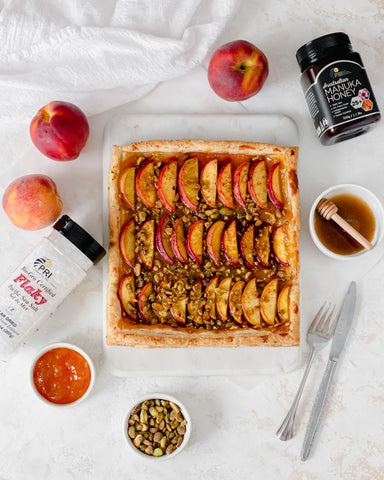
Peach Pistachio Cardamom Honey Tart

Peach Pistachio Cardamom Honey Tart

Wanna wow them with a dessert but it’s not your forte or you just don’t have time for fancy kitchen antics? The answer is Peach Pistachio Cardamom Honey Tart.


The most complicated thing about this dessert is it’s name with only 8 ingredients and crazy good flavor. Use premade puff pastry and time to oven is under 30 minutes. Add another 30 minutes to bake and bobs-your-uncle! 


You could drizzle the sauce over the top while everyone is watching for extra drama & anticipation but this dessert really needs no theatrics to make it a hit. 


Peach Pistachio Cardamom Honey Tart


Ingredients:

  • 1 sheet puff pastry, thawed
  • ⅓ cup pistachios, pulsed in food processor or roughly chopped
  • ¼ - ⅓ cup peach preserves or peach jam
  • 4 peaches 
  • 2 tbsp PRI Manuka Honey
  • 1 tsp vanilla
  • ½ - 1 tsp cardamom
  • PRI Flaky Sea Salt


Instructions:

  1. With a sharp knife, cut peaches into sliced shapes, whatever shape desired.
  2. Preheat oven to 400F.
  3. Remove thawed puff pastry from the box and place on a silpat mat or parchment lined baking sheet.
  4. Use a knife to score a ½” border, be careful not to cut all the way through the dough.
  5. Using a spoon or pastry brush, spread peach preserves on the puff pastry within the scored border.
  6. Sprinkle half the pistachios on the puff pastry within the scored border. Place your sliced peaches over the preserves in whatever design preferred. Finally, sprinkle the rest of the pistachios over the peaches. 
  7. Bake in oven for 25-30 minutes or until the pastry dough has puffed up and is golden on the edges.
  8. While baking, in a small bowl, combine manuka honey, vanilla and cardamom. Stir until well combined.
  9. Once the tart is finished baking, remove from the oven and drizzle with manuka honey and cardamom mixture, top with flaky sea salt and serve! Enjoy!
Read more
Notice of PRI Free Shipping Policy Change

Notice of PRI Free Shipping Policy Change [2026]

PRI is updating its shipping policy on May 8, 2026. Learn how we are maintaining our quality standards and how you can save before the change.

Read more
When is the Best Time to Take Manuka Honey: Morning or Night?

When is the Best Time to Take Manuka Honey: Morning or Night?

  • Morning use on an empty stomach maximizes absorption for digestion and energy, while evening use is ideal for soothing the throat and supporting overnight recovery.

  • Beyond the morning and night rituals, Manuka honey serves as an excellent natural pre-workout boost, a mid-afternoon energy lift, or a proactive digestive aid before meals.

  • For the best results, use authentic, raw MGO-tested honey consistently and consult a professional regarding specific health needs or pediatric safety.

Many people start their day feeling slightly sluggish or experiencing digestive discomfort. While a cup of coffee is the standard American response, it often leads to a mid-morning crash. This has led many wellness enthusiasts to ask a specific question: is it better to take manuka honey morning or night?

Manuka honey contains the unique nectar from the New Zealand Manuka bush (Leptospermum scoparium), recognized for its high levels of methylglyoxal (MGO). This compound gives it potent antibacterial and wellness properties that distinguish it from regular clover honey. While you can enjoy it at any time, many find that having a spoonful first thing in the morning, particularly on an empty stomach, is the best way to maximize Manuka honey benefits

In this article, we’ll compare morning versus night use of Manuka honey and share practical tips for incorporating Manuka honey into your morning routine for the ideal outcome.

Manuka Honey Morning or Night: When’s the Best Time?

Whether you should take Manuka honey in the morning or evening depends on your specific health goals. Both timings offer distinct advantages for your daily routine.

The Case for Morning (On an Empty Stomach)

Taking a spoonful upon waking is often considered ideal. Without interference from other foods, your body can more efficiently absorb its bioactive compounds and enzymes.

  • Kickstarts Digestion: Provides a soothing, protective coating for your stomach and offers gentle support for a happy gut, especially if you’re dealing with the discomfort of H. pylori and need a little extra antibacterial help in addition to your antibiotics.

  • Consistent Energy: Provides a clean, natural energy source to power your morning.

  • Enhanced Wellness: Helps support daily immune function by providing essential nutrients to maintain natural defenses.

Pro Tip: Consume one to two MGO 60+ Manuka honey sticks (roughly equivalent to 1 teaspoon per stick) directly or stirred into warm lemon water to start your day right.

The Case for Night (Before Bed)

Consuming honey before sleep is ideal for relaxation and supporting the body’s overnight recovery phase.

  • Soothes the Throat: Helps to provide immediate relief for persistent coughs that may disrupt sleep.

  • Overnight Digestion: Helps calm the digestive system while the body is in its natural repair state.

Pro Tip: Our Lemon Honey Cough Elixir can be mixed into a warm cup of herbal tea to create a soothing, bedtime tonic that helps you unwind while easing throat irritation. 

If you prefer a mess-free option, keep our Manuka honey throat lozenges on your nightstand to quickly help calm a dry, scratchy throat and support a peaceful night’s rest.

The Verdict

The “best” time is whichever fits your desired results: morning for digestive balance and all-day immune support, or night for its soothing, relaxing benefits.

Ultimately, consistency is what matters most. Listen to your body and adjust your timing to find what works best for you.

Other Targeted Timing to Consider to Enjoy Manuka Honey Benefits

While morning and night are the most common anchors for a wellness routine, Manuka honey’s versatile profile makes it an excellent ally at various points throughout the day. Depending on your lifestyle, these targeted timings can help you maximize specific functional benefits.

Before Meals for Digestive Support

Taking Manuka honey approximately 20 to 30 minutes before a meal can act as a proactive measure for your digestive system. The bioactive properties of Manuka helps support a balanced gut microbiome and provide a soothing buffer, which can be particularly beneficial for those who experience discomfort or bloating after eating.

Pre-Workout for a Natural Boost

Ditch the synthetic pre-workout powders for a natural, whole-food alternative. Consuming a serving of Manuka honey 15 to 30 minutes before exercise provides a quick-release fuel source for your muscles.

Mid-Afternoon for an Energy Lift

That 3:00 PM slump is often when focus wanes and sugar cravings hit. A mid-afternoon dose of Manuka honey serves as a functional snack that satisfies your sweet tooth while clearing mental fog.

For families on the go, our kid-approved Manuka honey nuggets are a convenient and functional way to snack. These portable bites offer the same immune-supporting benefits in a mess-free format, making it easy to keep the whole family energized until dinner.

Important Considerations When Incorporating Manuka Honey into Your Daily Routine

To get the most out of your daily ritual, it’s important to prioritize both the authenticity of your honey and the specific needs of your household. Here is how to ensure your experience is both effective and safe.

Prioritize Purity and Provenance

The efficacy of Manuka honey is directly tied to its quality. To see genuine results, your honey must be raw, unpasteurized, and independently lab-tested for its MGO content.

As the first company to introduce Manuka honey to the U.S. market, Pacific Resources International (PRI) maintains a legacy of trust. We source our Manuka honey directly from New Zealand beekeepers, ensuring every jar is a potent, reliable, and authentic representation of nature’s best work.

Mindful Consumption

While Manuka is rich in bio-activity that offers numerous health benefits, it’s important to practice moderation and caution, particularly regarding pediatric safety and specific dietary needs.

  • Blood Sugar Management: If you are managing diabetes, please monitor your blood glucose levels and account for the honey within your daily carbohydrate intake.

  • Infant Safety: Due to the risk of infant botulism, honey in any form should never be given to children under one year of age.

  • Professional Guidance: We always recommend consulting with a healthcare professional if you have specific medical conditions, are pregnant, or have concerns about introducing new functional foods to your diet.

Get the Most of Out of Manuka Honey With High-Quality Options From PRI

Starting your day with Manuka honey is an excellent way to support your body naturally. Taking it first thing in the morning often enhances absorption and sets you up for better digestion, energy, and wellness support compared to later in the day for many goals.

Whether you prefer manuka honey morning or night, the key is choosing good quality Manuka honey and staying consistent. Give Manuka honey a try and build a simple ritual that works for you.

Ready to start your day right? Explore high-quality Manuka honey from Pacific Resources International and feel the difference.

Frequently Asked Questions About the Best Time to Take Manuka Honey

Is it better to take Manuka honey in the morning or at night? 

While both are fine, the morning is generally better for absorption and digestive support. Taking it at night is more beneficial in helping to soothe a sore throat or helping with overnight recovery.

Can I take Manuka honey every day, and how much? 

Yes. For most adults, 1 to 2 teaspoons daily is a safe and effective amount for maintaining wellness.

Does taking Manuka honey on an empty stomach really make a difference? 

Many enthusiasts find it does. Starting your day with a spoonful allows the honey to gently coat your digestive path without any interference. This ensures you get the full, concentrated benefits of its active properties before they get mixed in with a full meal. 

Note, however, that at present, no Manuka-specific RCTs confirm this over other times, and absorption claims are mostly from anecdotal evidence.

Read more
High-Strength vs. Low-Strength Manuka Honey

High-Strength vs. Low-Strength Manuka Honey

  • Methylglyoxal (MGO) is the core compound that gives Manuka its unique, heat-stable antibacterial power, setting it apart from regular honey.

  • While low-strength Manuka is ideal for daily sweetening, high-strength Manuka honey (MGO 500+) is necessary for targeted health benefits.

  • Selecting the best Manuka honey brand requires looking for third-party testing and traceability, ensuring you receive the potent bioactivity you pay for.

Manuka honey has surged in popularity, prized for health benefits that go far beyond your average pantry staple. While clover and wildflower honeys are excellent natural sweeteners, Manuka is in a league of its own thanks to its potent antibacterial and anti-inflammatory properties.

The secret lies in a compound called Methylglyoxal (MGO). However, simply having “Manuka” on the label isn’t enough; the concentration of MGO is a helpful guide in distinguishing between a high-potency functional food and a standard natural sweetener ideal for daily use.

In this article, we’ll discuss what MGO is in Manuka honey, compare different strengths, and explore the various Manuka honey health benefits. We’ll also help you identify the ideal Manuka honey strength for your needs.

What Is Manuka Honey and Why Does Strength Matter?

Manuka honey is produced by bees that feast on the nectar of the Manuka bush (Leptospermum scoparium), which is native to New Zealand. What sets it apart is its “non-peroxide” antibacterial activity (NPA), which means that it’s considerably stable even when exposed to heat or light. While most honey loses its antibacterial effectiveness when exposed to heat or light, Manuka honey remains stable and potent.

The “strength” of the honey refers to the concentration of its active compounds (MGO). While you enjoy the same Manuka honey health benefits across all levels, a higher MGO rating indicates a more potent dose, providing a stronger and more concentrated level of support.

A low-strength honey is perfect for a morning tea, but it may not have the bioactive activity required for more demanding health concerns. Choosing the right strength ensures you’re not overpaying for daily use and that you’re getting the right amount of oomph for your specific concern.

Manuka Honey Health Benefits

The versatility of Manuka honey is one of its greatest advantages. Beyond acting as a natural sweetener, high-strength Manuka honey is a potent functional food. Its high MGO levels offer a scientifically backed approach to several key wellness areas:

  • Wound and Skin Support: High-strength Manuka honey can help soothe the pain associated with minor burns and abrasions. It creates a protective, antibacterial barrier that supports the natural healing process.

  • Sore Throat and Cough Support: Individuals looking for comfort in their sore throat and cough. The viscous texture coats the throat, while the MGO works to neutralize bacteria. This is why many people buy Manuka honey or Manuka-honey containing cough elixirs specifically for the winter months.

  • Digestive and Gut Health Support: Manuka honey acts as a prebiotic, feeding the good bacteria in your gut and helping to manage inflammation in the digestive tract.

  • Oral Health Support: Research suggests that Manuka can help reduce plaque and support healthy gums by targeting harmful oral bacteria.

What Is MGO in Manuka Honey?

When you look at a jar of Manuka honey, you’ll see a number next to the letters “MGO.” This is the most important indicator of the honey’s power. MGO stands for Methylglyoxal, the naturally occurring compound responsible for Manuka’s unique properties that makes it ideal for uses related to health and wellness support.

MGO is measured in milligrams per kilogram (mg/kg). Simply put, a higher MGO number means a higher concentration of antibacterial properties. For example, a jar labeled MGO 500+ contains at least 500mg of Methylglyoxal per kilogram of honey. 

The MGO grading system is essential for identifying the potency of Manuka honey by providing a clear, scientific measurement of the honey’s strength. It serves as a direct measurement of the magic ingredient that makes Manuka so famous.

High-Strength vs. Low-Strength Manuka Honey: A Detailed Comparison

Choosing between high and low-strength depends entirely on your goals. Both options offer Manuka honey health benefits, but they serve different purposes in your wellness routine.

Low-Strength Manuka Honey (MGO 60 to 250+)

This tier is ideal for consistent, everyday use. It has a milder, sweeter taste and is generally a cost-effective way to integrate Manuka into your lifestyle.

  • Best For: Sweetening yogurt, drizzling over oatmeal, or as a natural replacement for white sugar. 

  • Wellness Support: Helps provide a gentle immune boost and antioxidant support for general health.

  • PRI Recommends: PRI Manuka honey sticks are rated MGO 60+ and offer the convenience you need for your daily use.

High-Strength Manuka Honey (MGO 600+ to 1000+)

High-strength Manuka honey has a higher MGO rating and thus provides a more robust concentration of MGO. It has a much bolder, earthy flavor and can have a thicker texture.

  • Best For: Targeted Manuka honey health concerns such as digestive support, helping soothe a stubborn cough, or topical application for skin issues.

  • Potency: This is the choice for those who need a bit more oomph during times of illness or physical stress.

Aspect

Low-Strength/Daily Potency

High-Strength/High Potency

MGO Range

60 to 250+

600+ to 1000+

Strength

Gentle, consistent dose

Concentrated, robust dose

Taste

Milder, sweet

Bolder and earthy

Price

More affordable for daily use

Premium investment for wellness support

Matching Strength to Your Wellness Goals

To find the best Manuka honey for your pantry, consider your primary reason for buying it.

  • For Daily Use: If you just want to enjoy the flavor and a small wellness boost, MGO 100+ can be an excellent and cost-effective starting point.

  • For Targeted Support: MGO 300+ offers an increased concentration of active compounds, making it the sweet spot for helping with a scratchy throat or supporting gut health.

  • For Maximum Potency: MGO 600+ provides a robust, high-strength dose of support, recommended for intensive immune needs or as a concentrated topical for skin health support (MGO 600+ and MGO 1000+ are available on PRI).

Always look for independently tested products. A transparent brand will provide a Certificate of Analysis to prove the MGO levels listed on the jar are accurate, ensuring you get the potency you’re paying for.

Pacific Resources International: A Pioneer in Authentic Manuka Honey

When you are ready to buy Manuka honey, authenticity is everything. Given its status as a premium product, “fake” or diluted Manuka honey is unfortunately common in the marketplace. 

Pacific Resources International (PRI) stands out as a premier choice for discerning consumers. As the original importer of Manuka honey to the U.S., PRI helped establish the standards for the industry and remains a trusted leader today, ensuring every jar delivers the genuine bioactive benefits you expect.

PRI Manuka honey is sourced directly from sustainable beekeepers in New Zealand. Every jar is independently tested and features a QR code on the lid, allowing you to trace your honey back to its origin and verify its MGO potency. PRI stands out for this level of transparency, ensuring you get exactly what you pay for.

Get High-Quality Manuka Honey Made Accessible by PRI

Choosing the right Manuka honey strength shouldn’t feel like a chore. Whether you’re looking for a high-strength Manuka honey to give your immune system that extra “oomph” or just a reliable jar for your morning tea, we want to help you know exactly what’s inside, so you can make a choice that actually makes sense for your health and your budget.

At PRI, we believe wellness should be straightforward and transparent, focusing on genuine quality rather than over-the-top claims. Our Manuka is raw, unpasteurized, and brought straight from New Zealand to your kitchen. Every jar is independently tested and fully traceable, because we’re excited to share with you the goodness behind our Manuka honey. From daily rituals to nature’s heavy lifters, we’ve got the right strength for your family.

Shop for PRI Manuka Honey and find the perfect strength for your family today.

Frequently Asked Questions About High-Strength vs Low-Strength Manuka Honey

What is MGO in Manuka honey?

MGO stands for Methylglyoxal. It’s the naturally occurring compound that gives Manuka honey its unique antibacterial properties. The MGO number on the jar tells you how much of this compound is present; higher numbers indicate a stronger potency.

Is Manuka honey good for you?

Yes. It offers a range of Manuka honey health benefits, including antioxidant support, antibacterial action, and anti-inflammatory properties. It’s a functional food that supports the immune and digestive systems.

What are the benefits of Manuka honey?

The primary benefits include helping soothe sore throats, aiding digestion, supporting wound healing, and supporting oral health. Its non-peroxide activity makes it more effective than regular honey for these purposes.

How do you use Manuka honey for medicinal support?

For internal use (digestion or immunity), take 1 to 2 teaspoons daily straight from the spoon or in warm water. For topical use (skin issues), apply a thin layer of high-strength Manuka honey to a clean area and cover with a bandage.

What is the best Manuka honey brand?

The best Manuka honey brand is one that provides third-party lab results and traceable sourcing. Pacific Resources International is a trusted Manuka honey brand that’s highly recommended for its long history of transparency and high-quality Manuka honey.

Read more
How Manuka Honey Supports Digestive Balance Naturally

How Manuka Honey Supports Digestive Balance Naturally

  • Manuka honey helps target harmful pathogens while preserving the beneficial gut flora essential for a healthy microbiome.

  • Manuka honey acts as a prebiotic to feed “good” bacteria and provides natural enzymes that assist in breaking down food to reduce gas and bloating.

  • Manuka honey can help coat and calm the digestive tract, offering relief from reflux and general gut sensitivity.

Ever feel like your gut is calling the shots? From the discomfort of post-meal bloating to the mental fog caused by the gut-brain connection, digestive issues have a way of taking over.

But finding balance shouldn't be a struggle. Manuka honey, a rare substance from New Zealand, is changing the game for holistic health. It emerged as a functional superfood with remarkable potential for gut support.

In this article, we’ll explain how this gift from nature promotes balance and why it is a staple for holistic health.

What Is Manuka Honey?

Manuka honey is produced by bees that feast on the flowers of the Manuka bush (Leptospermum scoparium), a plant native to New Zealand. While all honey has some level of antibacterial activity due to hydrogen peroxide, Manuka contains “non-peroxide activity” (NPA) fueled by high MGO levels. This makes it much more stable and potent.

Manuka honey is known for its antioxidant and prebiotic effects, which contribute to a wide range of Manuka health benefits. While it’s famous for its health benefits like sore throat relief and its support to wound care efforts, its impact on the digestive system is one of its most valued traits. 

To ensure you’re getting the most out of these Manuka honey health benefits, it’s important to look at the MGO ratings on the label, which verify the honey's potency and authenticity.

How Manuka Honey Supports Digestive Balance Naturally

Achieving digestive harmony requires a multi-faceted approach. Manuka honey addresses gut health through several biological pathways, making it a versatile tool for those seeking Manuka honey digestion benefits.

Antibacterial Action Against Harmful Gut Bacteria

The gut is home to trillions of bacteria, but an overgrowth of harmful strains can lead to serious issues. Research suggests that Manuka honey can target pathogens like Helicobacter pylori (H. pylori), which is often linked to stomach ulcers, and Clostridioides difficile (C. difficile or “C. diff”), often linked to diarrhea and colitis

Unlike synthetic antibiotics that may strip the gut of all bacteria, Manuka honey helps manage these harmful strains while leaving the beneficial flora intact. However, note that Manuka honey is only a supportive way towards relief of digestive discomfort, not a replacement for standard medical therapy.

Prebiotic Effects for a Healthier Microbiome

A healthy gut relies on “good” bacteria like Lactobacillus. Manuka honey can act as a prebiotic, providing the necessary food for these beneficial microbes to thrive. By supporting the growth of good bacteria, Manuka honey helps facilitate better nutrient absorption and a stronger immune system.

Soothing Inflammation and Healing the Digestive Tract

Inflammation in the stomach lining or intestines can cause significant pain and bloating. The anti-inflammatory properties of Manuka honey may help reduce this irritation. Many individuals find that a small amount of honey helps calm symptoms associated with reflux or general gut sensitivity likely by creating a protective coating over the digestive membranes.

Supporting Natural Digestive Enzymes

Manuka honey contains natural enzymes that assist in the breakdown of food, particularly carbohydrates and fats. When food is digested more effectively, there is less opportunity for fermentation in the gut, which is a primary cause of gas and bloating. This leads to an overall smoother digestive process and less post-meal heaviness.

How to Use Manuka Honey for Digestive Support

Manuka honey is prized for the unique properties conferred to it by MGO, which is also a marker for its strength. Strength ratings on the lower end, like MGO 60+ Manuka honey in a jar or in Manuka honey sticks, are better suited for daily use and preferred as a natural sweetener. Meanwhile, those at the higher end are expected to provide the desired health and wellness benefits.

Be intentional with your choices for Manuka honey strength; make sure to choose according to your needs, especially when it comes to digestive support. Use the table below as your guide (note, however, that these ratings indicate laboratory potency, not a guaranteed clinical outcome):

MGO Rating

Recommended Use

MGO 60+

Daily use; general wellness and daily digestive maintenance

MGO 100+

For immune support

MGO 200+ to 300+

Daily gut and skin maintenance; ideal for occasional digestive upset or bloating

MGO 600+

High-potency targeted support for specific gut concerns and other health needs; with concentrated prebiotic activity

MGO 1000+

Ultra-high-strength Manuka honey; our most potent specialized support for general and intensive seasonal challenges


In addition to choosing the right MGO rating, consistency and timing are key to allow you to experience the best results. It’s highly recommended to consume 1 to 2 teaspoons daily of MGO 600+ Manuka honey for digestive support.

  • Best Timing: Taking a spoonful on an empty stomach in the morning or about 30 minutes before a meal can help the honey coat the digestive tract effectively.

  • Method of Consumption: You can enjoy it straight from the spoon for maximum potency. If you prefer a drink, stir it into warm, not boiling, tea or water. High heat can damage the beneficial enzymes, so let your drink cool to a comfortable sipping temperature first. 

  • Safety Note: While Manuka is a powerful natural tool, it is not a substitute for professional medical treatment. If you have a serious chronic condition, always consult with a healthcare provider.

Enjoy Optimum Digestive Support With PRI Manuka Honey 

Manuka honey offers a gentle, evidence-backed way to support your digestive system without the need for harsh chemicals. Take advantage of Manuka honey’s antibacterial and prebiotic properties so you can maintain a balanced microbiome and reduce daily discomfort. These Manuka honey digestion benefits are an essential part of a holistic wellness routine.

At Pacific Resources International (PRI), we’re committed to providing you with access to high-quality Manuka honey that’s raw, unpasteurized, and traceable back to the New Zealand beekeepers. You can count on us for genuine New Zealand Manuka honey. We’ve become a go-to U.S. importer because we believe you deserve total transparency and the purest product possible.

If you’re looking to support your gut health, it helps to choose a honey you can truly trust. Buy Manuka honey from PRI and see what a difference authentic, high-quality honey can make.

Nature provides the tools for balance; PRI Manuka honey brings them to your table.

Frequently Asked Questions About Manuka Honey’s Digestion Benefits

Does Manuka honey help with digestion and bloating?

Yes. Its prebiotic nature feeds good bacteria, while its anti-inflammatory properties help soothe the gut lining. This combined action helps reduce the fermentation that causes bloating.

How does Manuka honey help with stomach ulcers, especially those caused by H. pylori?

Manuka honey has been studied for its protective effects against H. pylori bacteria, a leading cause of stomach ulcer. By reducing these bacteria and helping soothe the stomach lining, it can be a helpful part of a natural approach to ulcer management.

Is Manuka honey good for IBS or gut inflammation?

Some people report finding relief from IBS symptoms and other gut inflammation-related conditions like functional dyspepsia, when using Manuka honey, prompting studies on its use as a protective agent against these digestive disorders. Its ability to help calm irritated tissues in the digestive tract is hypothesized to help reduce the frequency of discomfort and promote a more stable gut environment.

How much Manuka honey should I take daily for digestive benefits?

For most adults, 1 to 2 teaspoons per day is sufficient. It’s best to start with a smaller amount to see how your body responds.

What is the best Manuka honey for digestion and where can I buy it?

The best honey is one that is raw and independently certified. At PRI, we’ve worked hard to build a reputation for quality. Ordering right from our website is the easiest way to make sure you’re getting the real New Zealand Manuka honey you’re looking for.

Read more
Chocolate ice cream in a waffle cone with honey jar and milk bottle in background

Ice Cream Recipe Round-Up

Have you been celebrating National Ice Cream Month? It’s so easy to make your own, even if you don’t have an ice cream maker! Here are our top four recipes to keep you cool:

1 - Coffee Sweet Potato Nice Cream: We really think we cracked the code on this one. It honestly tastes JUST like regular ice cream except you could literally eat this every day for breakfast and feel great!

2 - Dairy-Free Spicy Mexican Chocolate Soft Serve: Because some like it hot AND sweet! Soft serve is even easier to make without any gadgets or constant stirring and this one is dairy free too!

3 - Patriotic Honey Pops: Okay, these are not technically ice cream but they are cold, delicious, and fun to make with the kids. 

4 - Honey Labneh Ice Cream with Leatherwood Honey: Created by our friends at Spoonabilites, this one does actually require an ice cream maker but…if you are an ice cream aficionado and want to impress your taste buds with a totally unique experience featuring one of the rarest kinds of honey in the world then this one is for you!

Read more
Honey Candied Orange Peels

Honey Candied Orange Peels

This recipe is a little more time consuming than our usual, but it’s just too good not to share, plus it’s not technically difficult and it only has three ingredients, one of which is optional!

Our Honey Candied Orange Peels may be a little different from the ones you’re used to. The honey gives them more of a jelly texture vs the dryer texture you get when candying with sugar, but many who try them say they prefer a softer texture.

We finished these by dipping them in melted Raspberry Manuka Chocolates. This step is optional…though your taste buds may disagree.

Ingredients:

Instructions:

  1. Place parchment paper on a baking sheet and set aside.
  2. Fill a medium saucepan with water and bring to a boil. 
  3. Peel the oranges by slicing the sides off, and then scoring the skin to easily remove it in larger pieces. Be careful when removing the skin so you can have nice long pieces of orange peels.
  4. Place the orange peels into the saucepan and boil for 8 minutes. Then remove the orange peels with a large spoon, keeping the water in the saucepan. 
  5. Use a paring knife to remove the skin from the orange peel. You should be able to see no white stuff on the orange peel.
  6. Then cut the peels into ¼ inch strips.
  7. Bring the water back to a boil and continue boiling for another 8–10 minutes. Then drain using a strainer and set aside.
  8. In the sauce pan, combine 1 cup of manuka honey with 1 cup of water on high heat.
  9. After a few minutes, the mixture should begin to boil and bubble. Reduce the heat to medium and continue cooking for a few more minutes. Then lower the heat to low and simmer until a syrup forms. The syrup should be sticky and not watery.
  10. Next, add in the orange peels and simmer on low heat for 30-40 minutes, while stirring periodically so the syrup or orange peels doesn’t burn. Once the oranges are translucent it’s time to remove them.
  11. Place the orange peels on the parchment paper and let them dry overnight. Keep the remaining honey orange syrup for cocktails or to use as jam.
  12. Then enjoy!

An option but recommended step is to dip the candied orange peels in chocolate. Melt PRI Raspberry Manuka Honey Chocolate Patties in a double boiler and dip the end of each orange peel into the chocolate. Then let the chocolate sit in the fridge and enjoy the raspberry orange honey combo! 

Store in an airtight container in the fridge. 

Read more

Cold Relief Tip: Ditch the OJ & Reach for Dark Chocolate Instead!

A 2013 review of 29 clinical trials involving more than 11,000 people showed vitamin C supplementation did not consistently affect the duration or severity of the common cold. 

The authors of the study state: "The failure of vitamin C supplementation to reduce the incidence of colds in the general population indicates that routine vitamin C supplementation is not justified."

So what should you reach for when feeling ill? Research says Zinc! There have been many conflicting studies about Zinc over the years until more recently when scientists discovered that the key is to take zinc within 24 hours of experiencing symptoms. Furthermore, the studies showed that supplementation of Zinc for five months reduced the frequency of colds and antibiotic use. 

Zinc can be taken as a supplement, in lozenge or liquid form; however, many report a lasting bad aftertaste and upset stomach with these methods. Additionally, the most bioavailable form of Zinc is in food. Foods high in zinc include meat, legumes, nuts & seeds, and our favorite: dark chocolate.

Of course, eating more fruits and vegetables and ensuring you are getting the vitamins and minerals you need, including vitamin C, are essential to your overall health and will affect how often you get sick. 

Instead of juice, eat the whole fruit. Fruit juice contains high sugar content without fiber and other nutrients needed to process the sugars slowly. Additionally, eating whole fruits and vegetables is the best way for your body to absorb nutrients. 

Based on these factors and the effectiveness of Manuka honey for cold & flu symptoms, our Manuka Honey Dark Chocolate Patties are a great way to supplement some of your DV of zinc and Manuka honey to reduce symptoms and get you well faster! Dark chocolate lovers & vegans will enjoy the delicious dark chocolate bars from  Solomon’s Gold.

You can also incorporate dark chocolate & Manuka into tasty snacks your whole family will love! Here are a couple of our favorite recipes:

#1 - Chocolate & Honey Rice Cakes: top them with seeds & nuts for even more zinc!

#2 - Coffee Sweet Potato Nice Cream: because dessert can be nutrient-dense, delicious, AND decadent.

#3 - Chocolate Caramel Popcorn: perfect for movie night or an afternoon snack!

Read more
Dessert with ice cream topped brownie, Manuka honey jar, dark chocolate patties, honey dipper, and mug

Air Fryer Molten Honey Lava Cake

Gluten-Free & Ready in Under 30 Minutes!

Do you preplan your desserts, or do they happen on a whim? We never know when that post-dinner craving will strike. When it does, we’ll be ready with these fantastic lava cakes - just mix, wait and bake! 

As with many dishes, who invented lava cakes is in dispute. Some say it originated at a bake-off in 1966, while two pastry chefs each say they developed it in the 1980s, and another insists there was already a dessert like it in France before then. Many of us have a nostalgic connection to this dessert no matter where it began, as it became wildly popular in the 1990s. 

Lava cakes were named for their liquid chocolate center, and our recipe uses our favorite PRI Dark Chocolate Patties to create this ooey-gooey delicious core! Since the patties come in five flavors, you can pick your favorite! We tried caramel and coffee, which were both amazing!

The bonus of using manuka honey in your desserts is its impressive oral care benefits. Manuka Honey will help reduce plaque by preventing the development of biofilms, which make plaque harder to remove. It also restricts bacteria formation preventing tooth cavities and other gum problems like periodontal disease, gingivitis, bleeding, receding gums, dry mouth, and bad breath.

Of course, while brushing your teeth afterward is still recommended, you certainly wouldn’t get the same benefits from other sweeteners and other types of honey!

Serves: 1-2

Ingredients:

Instructions:

  1. Sift the oat flour, cocoa powder, espresso powder, cornstarch, baking powder, and salt.
  2. Then add in almond milk, manuka honey, and vanilla. Stir until the batter is well combined and the honey is incorporated throughout. Let the batter sit for 5-10 minutes to bubble up.
  3. Grease a ramekin with oil or spray and then fill it halfway with the batter. Then place in one or two manuka chocolate patties and fill to the top with the rest of the batter.
  4. Air fry for 12-14 minutes at 360°F. The cook time depends on the individual air fryer, so you check on it around the 8-minute mark. The longer you cook it, the less gooey it will be.
  5. Remove from the air fryer and let cool. Top with ice cream or powdered sugar, and enjoy!
Read more
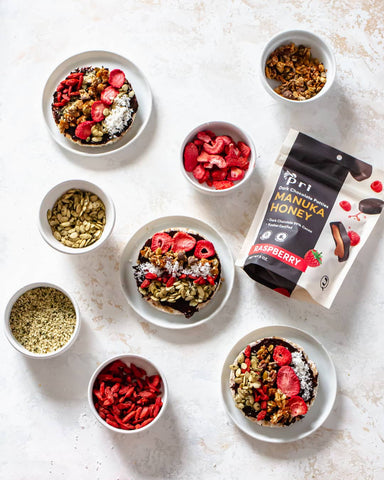
Manuka honey dark chocolate patties with raspberry, rice cakes topped with seeds and dried fruit

Decadent Chocolate Rice Cakes with Manuka Honey!

Out of all the creative ways to eat rice cakes, this is one of our favorites! We are constantly experimenting with our fun & flavorful Manuka Honey chocolates and this recipe is simple and perfect for kids & adults alike. This recipe will work especially well as an after school snack! 

Chocolate & strawberries pair well together in so many applications so we had to include them in this recipe! This goes without saying that Manuka Honey and strawberries also go together very well. Putting all of them together is a recipe for success! 

To make this rice cake recipe even more special, we included a variety of nuts that help add a saltiness that boosts the flavor profile of our chocolate rice cakes. Of course, this is in addition to the tremendous nutritional value in nuts (if you’re not allergic).

Coconut flakes are also a delicious topping for this snack! If you’re a fan of toasting your coconuts before adding them as a topping, feel free to take the extra time to do so. It should only take a few minutes to get a light toasting on them, or you can buy already toasted coconut shavings if you want to save time!


Ingredients

Produce

  • 2 tbsp dried strawberries
  • 2 tbsp Goji berries

Baking & Spices

Nuts & Seeds

  • 2 tbsp Coconut flakes
  • 2 tbsp Pumpkin seeds

Bread & Baked Goods

  • 12 Brown rice cakes

RECIPE

  1. Melt about 10 Raspberry Manuka Honey chocolates in a bowl
  2. Apply melted chocolate to rice cakes
  3. Arrange toppings to your liking!

If you’ve never tried our Manuka Honey chocolates on their own, they’re delicious in their own right! We like to treat our unique & healthy Manuka Honey treats as versatile snacks that can be used in so many recipes. Our chocolate flavors now include Salted Caramel, Coffee, Ginger, Mint, & Raspberry -- all of which can make for great options in this recipe and many more!

We crafted our special Manuka Honey chocolate patty recipe to be gluten-free & dairy-free without artificial colors, flavors, or preservatives so they can be healthy as possible & diet-friendly! 

Read more
Manuka honey cereal bars cut into squares with honey, milk, and peanut butter on a light table.

Peanut Butter Manuka Honey Cereal Bars

What makes the perfect snack? We like ours to be healthy, tasty & not straight out of a box. If we already have the ingredients, that’s an added plus! 

We hope these PB-MH Bars check all of your boxes too. It only requires about 10 minutes of your time and then a bit of patience while they firm up in the fridge. This is also a great recipe for the kids to help with and is easily customized. Here are some ways you could switch it up:

  • Use your favorite cereal
  • Use your favorite nut or seed butter
  • Add nuts, seeds or dried fruit
  • Melt your favorite Manuka Dark Chocolate Patty flavor over the top!

Any way you do it, they make a tasty part of a balanced breakfast, after-lunch dessert or on-the-go snack.

Here is what you need:

Instructions:

  1. Line an 8x8 square baking pan with parchment paper and set aside.
  2. In a large saucepan, combine peanut butter with manuka honey and coconut oil and stir on low heat until well incorporated throughout (2-3 minutes). 
  3. Turn the heat off and stir in vanilla and sea salt. Then add in 3 cups of cheerios and stir until they are covered in the peanut honey mixture. Pour in the remaining 3 cups and gently stir until well incorporated. It should be similar to rice crispy treats and stick together.
  4. Pour the cheerio mixture into the parchment lined pan and refrigerate overnight or for a few hours until firm.
  5. Slice into bars and enjoy! Store in an airtight container in the fridge to enjoy for a week or freeze to enjoy later.
Read more
85 results